

Last Updated: October 12, 2026
Identifying high quality handmade furniture comes down to a hands-on routine: study the wood grain, confirm solid wood construction, examine the joinery, check the finish, and test for stability. At Crooked Tree Woodworks, we build custom hardwood pieces every day, and most buyers skip these checks and regret it later.
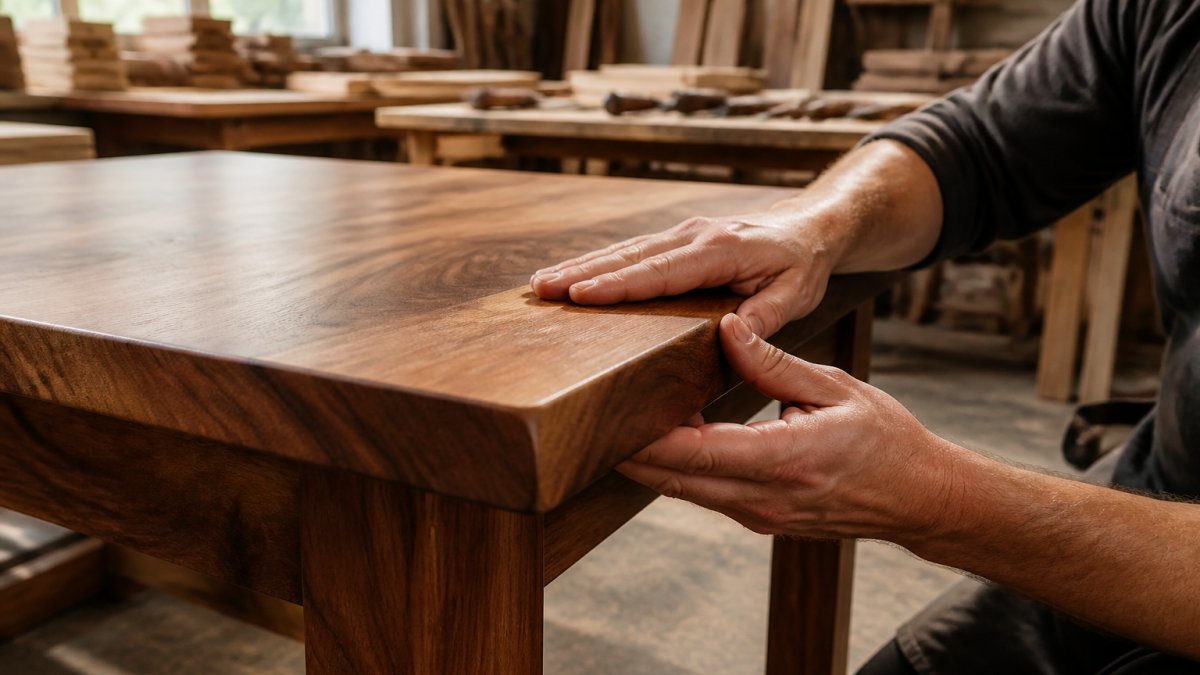
Start with the surface. Run your palm along the top and edges, then look at the wood from a low angle in good light.
Real wood grain is never perfectly uniform. Look for grain that shifts and flows across the board, with subtle color changes and small natural marks, proof of solid timber, not a printed pattern.
Here is what to check:
If every board looks identical, you may be looking at veneer or printed laminate, not always bad, but it changes what you pay for.
Solid wood is lumber cut from a single tree, milled and joined into a piece. Veneer is a thin slice of real wood glued over plywood or particle board. Engineered wood covers manufactured cores like plywood, MDF, or particle board, sometimes with a veneer top.
To tell them apart:
Solid wood costs more because it lasts longer and can be repaired; veneered furniture often cannot be sanded or refinished.
Joinery is the single best signal of handmade quality, and the hardest thing to fake. The strongest joints are dovetails and mortise-and-tenon, which lock wood together with geometry rather than glue or fasteners alone. Weak joints, such as butt joints held with screws or staples, loosen over time.
Each joint type sends a different message:
A dovetail is not automatically a sign of handwork, router jigs have been common in small shops for decades and produce clean, strong joints. What separates hand-cut work is the evidence of judgment around the joint.
Look for these signals:
None of these signals is proof on its own, a skilled maker with a jig can outdo a beginner cutting by hand. Read the whole joint, not one clue.
Look inside drawers and under tables, where makers either show their skill or hide shortcuts. Pull the drawer all the way out and check:
Uneven dovetails, gaps, or glue everywhere point to rushed work. Clean, tight joints with consistent shoulders and a few honest tool marks point to a maker who cares.
A good finish protects the wood and feels smooth. Check for even color, no drips, rough patches, or sticky spots; a hand-rubbed finish usually looks deeper and warmer than a thick sprayed coating. Run your fingers along every edge, sharp or rough edges mean poor sanding.
Look closely at these details:
Ask what finish was used. It determines how the piece ages and how easily it can be fixed. The common options behave very differently:
The more durable the film, the harder it is to repair invisibly. Oil and wax are forgiving but need attention; polyurethane and lacquer are tough but less forgiving. Neither is automatically better, the right choice depends on use.
You can learn a lot without touching the surface with anything that could mark it:
Finish is not just cosmetic. It slows moisture movement in and out of the wood, which causes boards to cup, crack, and separate at the joints over the seasons. A piece finished on all faces, including the underside, moves less and holds its joints longer than one finished only on top.
When comparing two pieces at similar prices, ask about the finish on both. The one with a documented finish schedule and clear care plan is usually the better long-term buy.
A stable piece does not rock, wobble, or creak; a strong piece holds its shape under load. Place it on a flat floor, press down on opposite corners, rock it gently, lean on the top, sit on a chair edge, and open and close every drawer and door.
Try these checks:
Weight is another clue. Solid hardwood is heavy; if a large table feels light, the core may be hollow or made from a lighter material. Weight alone does not prove quality, but it helps alongside the other checks.
The right questions separate a true craftsman from a reseller. Ask about materials, methods, timeline, and aftercare; a confident maker answers directly and shows examples, while vague answers are a red flag.
Bring this list with you:
For buyers who care about sustainability, ask for documentation on sourcing. The U.S. Forest Service guidance on sustainable forest management explains what responsible harvesting looks like, and the Forest Stewardship Council certification standards set a widely used benchmark you can ask a maker to meet.
Use this checklist to move from browsing to a confident purchase. Print it or keep it on your phone, and work through it in order.
| Stage | What to Check | Why It Matters |
|---|---|---|
| First look | Grain variation, solid wood vs. veneer | Confirms real materials |
| Joints | Dovetails, mortise-and-tenon, pegs | Predicts how long it lasts |
| Finish | Smooth edges, even seams, no drips | Shows care and protects wood |
| Stability | Rock test, drawer test, weight | Proves structural integrity |
| Maker | Sourcing, methods, timeline, repair policy | Reveals craftsmanship and trust |
| Delivery | Inspect on arrival, test again on hard floor | Catches shipping damage early |
One more step: photograph the piece from several angles before you commit and compare with the maker’s past work. Consistency across projects is a strong sign of a reliable craftsman.
Not every signal points the right way. A heavy piece is not always solid, a high price does not guarantee handmade work, a beautiful photo tells you nothing about the joints inside, and a maker who uses one dovetail joint may still cut corners elsewhere.
Watch for these traps:
Inspection has limits, too. You cannot see inside a glued joint, test how a finish will age in five years, or learn from one visit how a piece handles daily use.
When you buy online, ask for video of the actual piece, close-ups of the joints, and the underside. A maker who will not send them is telling you something.
Buying handmade furniture is a decision you live with for decades, and the inspection process above turns guesswork into evidence. If you want a piece built to your space, your style, and your family’s future, Crooked Tree Woodworks can help. We craft bespoke furniture from rare exotic hardwoods, using time-honored joinery and sustainable materials, all handmade in the USA. Request a Custom Quote and start a piece that becomes a legacy.
Start by examining the joinery. High-quality handmade furniture uses strong joints like dovetails or mortise-and-tenon, not just screws and glue. Check the wood grain for natural variation and continuity; solid wood will have grain that flows across the piece. Look for a hand-rubbed finish that feels smooth and even. Also, test stability by gently rocking the piece. Finally, ask the maker about their materials and process. A genuine craftsman will welcome these questions and provide detailed answers.
Look for solid wood construction, not veneer or engineered wood, unless the maker explicitly states otherwise. Inspect the joints: dovetail and mortise-and-tenon are signs of durability. Check the finish for evenness and smooth edges. Examine the grain matching and natural variation, which indicate real wood. Ask about the wood species and its origin. Request a custom furniture buying checklist from the maker if they have one. Also, verify the maker’s reputation and ask for examples of previous work to ensure authenticity.
The strongest joints in handmade furniture are mortise-and-tenon, dovetail, and dowel joints. Mortise-and-tenon involves fitting a tenon into a mortise, creating a mechanical lock that resists twisting. Dovetails interlock like puzzle pieces and are excellent for drawers. Dowels, when properly glued, add strength. Screws and nails are weaker and often indicate lower-quality construction. When inspecting, look for tight, well-fitted joints with no gaps. Reinforced corners and wooden pegs are also positive signs of craftsmanship.
Run your hand over the surface; it should feel smooth without rough spots or drips. Look at the finish in natural light to check for evenness and sheen. A hand-rubbed finish, such as oil or wax, often has a deeper, more natural look than a thick lacquer. Check edges and corners for consistent coverage. Ask the maker what type of finish they use and how to maintain it. A quality finish protects the wood and enhances its grain, so it should not look plastic or overly glossy.